7inch IPS HD Touch Screen-D 1024*600 HD Monitor Compatible with Raspberry Pi/BB Black, etc
Description
7inch IPS HD Raspberry Pi Display
This 7-inch HDMI display features an IPS panel with a native resolution of 1024×600 and supports up to 1080P, delivering a richly detailed and vibrant visual experience. The screen utilizes a 5-point capacitive touch solution, enabling driverless touch control via USB, providing a smooth and responsive operating experience on Windows and various development platforms. The device also supports USB dimming, with accompanying software allowing for online dimming.
This 7-inch screen features an OSD menu, allowing easy adjustment of parameters such as brightness and contrast. Its excellent compatibility fully supports Raspberry Pi series development boards (compatible with Raspbian/Ubuntu/Win10 IoT systems, supporting multi-touch, driverless), perfectly matching the entire Windows 7 to 11 operating system series (achieving five-point touch, driverless), and can also connect to mainstream gaming devices such as PS4 and Xbox. An acrylic stand is included, and its innovative retractable interface design, along with pre-drilled mounting holes on the back, allows for easy mounting of Raspberry Pi and other development boards directly to the back of the screen, creating an integrated solution.
The 7-inch screen has passed multiple international certifications, including CE and RoHS, ensuring stable and reliable performance in applications such as development and debugging, industrial control, and multimedia entertainment.
OEM customization requests can be discussed for projects.
Model DLH05170B

Feature
- High-definition IPS display: 7-inch IPS screen with a 1024×600 physical resolution, supporting 1080P signal input, providing a wide viewing angle and delicate image quality.
- Sensitive touch: 5-point capacitive touch, USB driverless operation, smooth operation.
- Professional functions: Equipped with an OSD menu to adjust brightness, contrast, etc., and supports USB software dimming to meet professional needs.
- Wide compatibility: Compatible with mainstream mini PCs such as Raspberry Pi (¾/5), BB Black, and Banana Pi; supports Raspbian, Ubuntu, WIN10 IoT, and other systems; supports Windows ⅞/8.1/10/11 systems and game consoles such as PS4 and Xbox.
- Integrated design: Unique recessed interface design, optimized for back-mount installation of development boards such as Raspberry Pi, compact structure, saving space.
- Professional certification: CE and RoHS certified, safe and reliable.
Specification
| Display size | 7.0inch |
|---|---|
| Display type | IPS |
| Touch IC | GT911 |
| Field of view | 178° |
| Touch Type | Capacitive 5-point Touch |
| Resolution | 1024×600 |
| Backlight Type | White LED |
| Backlight Brightness | 320cd/m2 |
| Refresh Rate | 60Hz |
| Response Time | 5 ms |
| Power Voltage | 5V (USB Type-C) |
| Power Consumption | 2.55W |
| Video Input Interface | HD/FPC Display Port |
| Touch Interface | USB/4P-1.25mm Port |
| Active Area | 154.21 x 85.92 mm |
| Dimensions | 164.90*102.00*15.15 (mm) |
| Net Weight | 223g |
Hardware Description
| Name | Description |
|---|---|
| Menu/Return | Open/Close the System Settings Menu; Return |
| Power | Connect to the power supply using Type-C cable, only providing power supply function and Touch |
| Display interface | Input HDMI signal, commonly used to connect to a computer |
| HD Interface | Input HDMI signal, connect using Mini HDMI cable, commonly used to connect to a computer |
| Earphone | 3.5mm audio output interface for connecting audio devices, such as headphones or audio systems |
| PWM | The backlight brightness can be adjusted by using PWM through external wiring |
| Up/Brightness Increase | Shortcut key, backlight brightness increase; In the System Settings Menu, Up |
| Down/Brightness Decrease | Shortcut key, backlight brightness reduction; In the System Settings Menu, Down |
| Left/ Volume Reduction | Shortcut key, Volume reduction; In the System Settings Menu, Left |
| Right/Volume Increase | Shortcut key, Volume increase; In the System Settings Menu, Right |
| Raspberry Pi hole | 2.5mm copper post, which can be used to connect and fix the Raspberry Pi |
Pin Definition of the 20Pin-0.5mm-FPC Expansion Interface
| Number | Name | Description | Number | Name | Description |
|---|---|---|---|---|---|
| 1 | NC | Floating | 11 | RXC_P | Clock transmission pin, used to transmit the differential clock signal |
| 2 | RX0_N | Data transmission pin, used to transmit the differential data signal of channel 0 | 12 | GND | Ground |
| 3 | GND | Ground | 13 | RXC_N | Clock transmission pin, used to transmit the differential clock signal |
| 4 | RX0_P | Data transmission pin, used to transmit the differential data signal of channel 0 | 14 | NC | Floating |
| 5 | RX1_N | Data transmission pin, used to transmit the differential data signal of channel 1 | 15 | NC | Floating |
| 6 | GND | Ground | 16 | HDMI SCL | IIC clock line, which provides a clock signal for data transmission |
| 7 | RX1_P | Data transmission pin, used to transmit the differential data signal of channel 1 | 17 | HDMI SDA | IIC data line, used for actual data transmission |
| 8 | RX2_N | Data transmission pin, used to transmit the differential data signal of channel 2 | 18 | GND | Ground |
| 9 | GND | Ground | 19 | HDMI 5V | Power pin, providing 5V power supply |
| 10 | RX2_P | Data transmission pin, used to transmit the differential data signal of channel 2 | 20 | HDMI HPD0 | It is the hot-plug detection signal pin in the HDMI interface |
4Pin-1.25mm Touch Expansion Interface Definition
| Pin | Identifier | Function Description |
|---|---|---|
| 1 | 5V | Power pin, providing 5V power supply |
| 2 | D+ | Data transmission pin, used to transmit differential data signals |
| 3 | D- | Data transmission pin, used to transmit differential data signals |
| 4 | GND | Ground pin |
Usage Instructions
Working with Raspberry Pi
Step 1. Download the Official image
1) Download Raspbian Official Image
Download URL: https://www.raspberrypi.org/downloads/raspbian/
Username: pi Password: raspberry
2) Download Ubuntu Mate Official Image
Download URL: https://ubuntu-mate.org/download/
The user name and password can be set by yourself after startup
3) Download Kail Official Image
Download URL: https://www.offensive-security.com/kali-linux-arm-images/
Username: kali (The old version is root) Password: kali(The old version is toor)
4) Download Retropie Official Image
Download URL: https://retropie.org.uk/download/
Username: pi Password: raspberry
Step 2. Brun Official Image
1) Download and install tool software(If they are already installed,this step can be ignored)
SD card format software SDCard Formatter download URL :
https://www.sdcard.org/downloads/formatter_4/
Image burning software win32diskimager download URL:
https://sourceforge.net/projects/win32diskimager/
2) Format SD card
Insert the SD card into the card reader -> Insert the card reader into the computer -> Open the SDFormatter software -> Select SD card -> Select quick format (generally select quick format, other options can be selected according to your own needs) -> Click the Format button -> Select "Yes" -> Click OK after formatting.
3) Brun Image
Open the win32diskimager software -> Select the image file to be burned (xxx.img ) -> Select SD card -> Click the "write" button -> Select "Yes" -> Wait for the burning to complete (the whole process lasts about 10 minutes)
Step 3. Modify the “config.txt” configuration file
Open the “config.txt” file in the root directory of SD card on the computer, Add the following at the end of the file, save and exit.
max_usb_current=1
hdmi_force_hotplug=1
config_hdmi_boost=7
hdmi_group=2
hdmi_mode=87
hdmi_drive=1
display_rotate=0
hdmi_cvt 1024 600 60 6 0 0 0
Step 4. Insert SD card
After the above steps are completed, pop up the SD card on the computer and insert it into the SD card slot on the back of the raspberry pie.
Step 5. Running system
Connect the HDMI interface and touch interface of the display screen to raspberry pie, connect the power supply of raspberry pie, and start the machine to display and touch normally.
Windows System - USB Dimming Software Guide
Step1. Download and Extract USB Dimming Software (Windows)
LCD-USB-BRIGHTNESS-Windows-V1.0
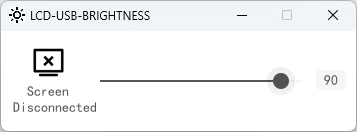
Step2. Run LCD-USB-BRIGHTNESS-Windows-V1.0.exe
-
Displays "Screen Disconnected" when not connected
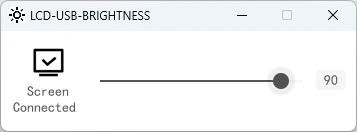
Step3. Connect Display USB to PC
-
Shows "Screen Connected" with real-time brightness adjustment • Saves last brightness setting.
How to Use as a Computer Display

- Use an HDMI cable to connect the computer's HDMI output signal to the HDMI interface of the LCD;
- Connect one end of the MicroUSB cable to the USB Touch interface of the LCD (either of the two MicroUSB ports can be used), and the other end to the USB port of the computer.
- If there are multiple displays, please first unplug the interfaces of other displays and test this LCD as the only display.
How to rotate the display direction
This method only applies to the Raspberry Pi series of display screens, other display screens do not apply.
-
Method 1,If the driver is not installed, execute the following command (Raspberry Pi needs to connected to the Internet):
sudo rm -rf LCD-show
git clone https://github.com/goodtft/LCD-show.git
chmod -R 755 LCD-show
cd LCD-show/
sudo ./XXX-show 90
After execution, the driver will be installed. The system will automatically restart, and the display screen will rotate 90 degrees to display and touch normally.
( ' XXX-show ' can be changed to the corresponding driver, and ' 90 ' can be changed to 0, 90, 180 and 270, respectively representing rotation angles of 0 degrees, 90 degrees, 180 degrees, 270 degrees) -
Method 2,If the driver is already installed, execute the following command:
After execution, the system will automatically restart, and the display screen will rotate 90 degrees to display and touch normally.
( ' 90 ' can be changed to 0, 90, 180 and 270, respectively representing rotation angles of 0 degrees, 90 degrees, 180 degrees, 270 degrees)
If the rotate.sh prompt cannot be found, use Method 1 to install the latest drivers -
Images Download
Image Name Version Support Default Password Raspberry Pi OS 2024-11-19 PI5/PI4/PI3B+/PI3/PI2/ ZERO/ZERO W user:pi
password:raspberryUbuntu MATE-32bit 22.04 PI4,PI3,PI2 user:pi
password:raspberryKali Linux RaspberryPi 2, 3 and 4 2024.3 PI4B,PI3B+,PI3,PI2 user: kali
password: kaliretropie-buster-rpi4 4.6 PI4B user:pi
password:raspberryretropie-buster-rpi2_rpi3 4.6 PI3B+,PI3,PI2 user:pi
password:raspberryretropie-buster-rpi1_zero 4.6 PI1,PI ZERO/ZERO W user:pi
password:raspberryImage Name Version Download Raspberry Pi OS 2024-11-19 Google https://drive.google.com/drive/folders/12peFjEysc-GIrA8_9OgTbs4Sw6d_h6O2?usp=sharing Ubuntu MATE-32bit 22.04 Google https://drive.google.com/drive/folders/1Bi-ooJK8rbE4tq1qiDT0hLzqwRQ8P70m?usp=sharing Kali Linux RaspberryPi 2, 3 and 4 2024.3 Google https://drive.google.com/drive/folders/13_MRFh1t3nJsK_ql2_XuGgc6FvmT4410?usp=sharing retropie-buster-rpi4 4.6 Google https://drive.google.com/drive/folders/1GLguISlPXI9pHNGgFRRMGz4x_Eqr-oxc?usp=sharing retropie-buster-rpi2_rpi3 4.6 Google https://drive.google.com/drive/folders/19ZhzZpC4K-sW3bVs1F6SLmP9-yEWP79d?usp=sharing retropie-buster-rpi1_zero 4.6 Google https://drive.google.com/drive/folders/1iuIcegTXaxat3W2XbdTvpyt4Bxnx7Kyr?usp=sharing
Resources
How to buy
Please visit this page to purchase 7inch IPS HD Touch Screen-D.
Support
If you have any problem about how to use it, you can connect to us at the bottom-right of bazzer or contact to techsupport@elecrow.com to get technology support.